I have been a developer for over twenty years. In that time the tools, the languages, the frameworks, the platforms and the expectations of what a website or system should do have changed continuously. Every few years something new arrives that changes how you work: broadband, smartphones, cloud hosting, modern JavaScript frameworks. You adapt, you learn, you carry on. Some of it is genuinely significant. None of it prepared me for the last eighteen months.
That is not hyperbole. It is a straightforward description of what it has felt like to watch AI tools evolve from curiosity to genuine working partner.
From Sceptic to Collaborator
Two years ago I was sceptical in the way most developers are sceptical about new tools that arrive with outsized claims. AI code assistants existed but they were unreliable, repetitive and more productive at generating plausible-looking nonsense than genuinely useful output. The conversations with language models were impressive in a parlour trick sense. They were not something you could actually work with.
That changed gradually, then quickly. The models got better at understanding context. The outputs got closer to what I actually needed. The hallucinations became less frequent. And my own understanding of how to use them properly, what to ask, how to direct rather than just request, improved alongside the technology.
The key shift was moving from arguing with AI to working with it. Early use was a lot of "that is wrong, try again." Current use is much more like handing someone a problem and having a genuine conversation about how to approach it. That is a different relationship entirely, and it changes what becomes possible.
I am not alone in that shift. 84% of developers now use or plan to use AI tools, up from 70% in 2023, with just over half using them every single day.1 The scepticism that marked the early adoption period is giving way to something more grounded: real, daily use by people who have worked out what these tools are actually good for.
Developer AI adoption, 2025
The shift to AI-assisted development is already mainstream. The workload implications are following.
Use or plan to use AI tools
Up from 70% in 2023
Use AI tools daily
Professional developers
Struggle with work pace and volume
Since AI adoption grew
Sources: Stack Overflow Developer Survey 2025; Microsoft Work Trend Index 2025
The Moment That Changed Everything
If I had to pick a single point that crystallised what is actually happening here, it would be the first serious session with Claude Code.
I have used many AI tools: code assistants, language models, image generators, audio tools. Each impressive in its own way. Claude Code was different. Not because of any single capability, but because of what it changed about the nature of the conversation.
Previously, my questions to AI about code were reactive. How do I do this? What is the best way to handle that? Why is this not working? The AI was a reference tool, faster than Stack Overflow, more contextual than documentation, but fundamentally answering questions I already knew how to frame.
With Claude Code having actual oversight of the project, the questions changed. I could ask things I had never been able to ask before. What am I missing here? What would you do differently? What are the risks I have not accounted for? What could this become?
That sounds like a small shift. It is not. Getting answers to questions you did not know to ask is qualitatively different from getting better answers to questions you already had. I can honestly say that in twenty years of technology changing constantly around me, nothing has landed like that. It was one of those moments where you think: this is going to change what I have known for the best part of two decades.
It Spread to Everything
Code was where it started. It did not stay there.
I began using AI as a design and UX colleague, bouncing ideas off it early in projects rather than going away and thinking in isolation. Using it to stress-test decisions, to find angles I had not considered, to work through problems that used to require a meeting with another person to resolve properly. That last bit matters more than it sounds. The friction of organising a conversation, waiting for availability, briefing the right person, is gone. The conversation happens now, whenever I need it.
I am writing this article at half eleven at night. Earlier, I spent an hour and a half parked up at my son's football training, talking to Claude about the ideas I wanted to get across in this piece. Not typing. Talking. The voice recognition, the understanding of context, the ability to keep up with how fast I talk and how fast I jump between ideas, has reached a point where the conversation is genuinely useful. Two years ago that was not true. A language model could not reliably follow the pace, the accent, the leaps in reasoning. Now I can have a real exchange that helps me develop thinking in real time, in a car park, at night, while my son does football training.
That is new. And it is, I think, genuinely extraordinary.
The Paradox
I am a to-do-list person. I plan obsessively. I like to start something and finish it. Modern work rarely allows that, so you spread your capability across several projects, moving each one forward incrementally. That has always been the reality of professional life.
AI has changed it. I can now close things out faster. I can work three or four routes to finishing something simultaneously. It is not unusual for me to have multiple instances of Claude Code running on different projects, plus a research thread, plus a writing session, all moving at the same time. Things that used to take days take hours. Things that used to require skills I did not have are now achievable.
But here is the paradox, and it is real.
As I clear a list, the act of clearing it surfaces more. Each problem I solve reveals the next problem that is now within reach. Each project I finish opens a question: what could this become? What else becomes possible now? I build another list. And another. The list grows faster than I can clear it.
AI did not create more work. It made me see more of the work that was always possible, and I cannot unsee it. The capacity to notice opportunity has outrun the capacity to act on all of it.
I am busier than I have ever been, doing work I am more excited about than I have been in years. I would not go back.
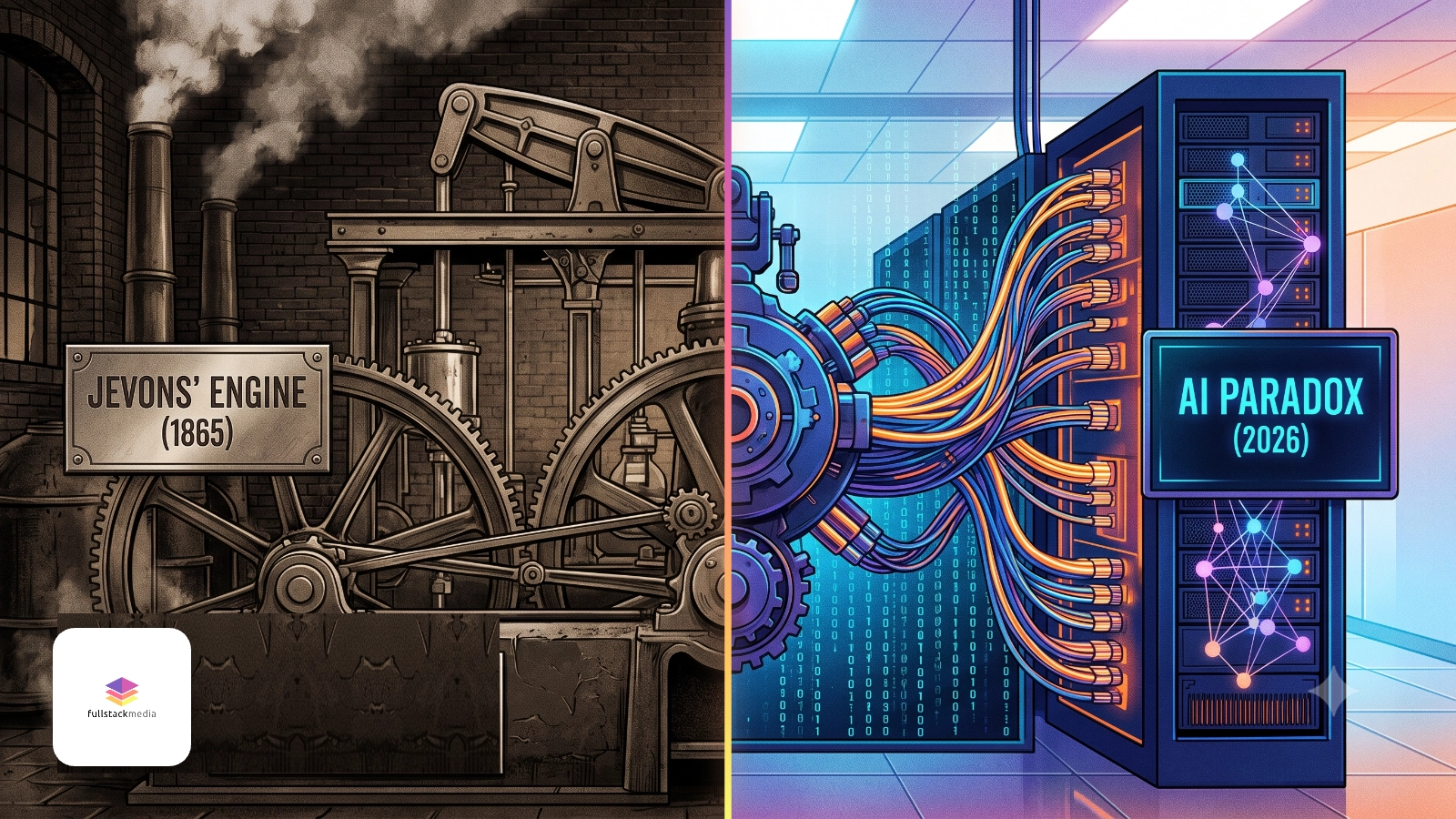
This pattern has a name, and it is older than AI by about 160 years.
In 1865, the economist William Stanley Jevons observed that more efficient steam engines did not reduce coal consumption across Britain. They increased it. Greater efficiency made coal viable for new uses, unlocked industries that had not previously existed, and expanded demand faster than the efficiency saving could absorb it. The resource did not go further. More of it got used.
AI tools follow the same logic. Every task that becomes faster reveals another task that is now worth attempting. Every project that takes hours instead of days opens a question that was previously too expensive to pursue. The tools do not free up time. They surface work that was always there, waiting for the capacity to reach it. 68% of employees say they now struggle with the pace and volume of work since AI adoption grew in their organisations.2 That is not a complaint about the tools. It is the Jevons Paradox playing out at scale.
The Jevons Paradox, applied to AI
Greater efficiency surfaces more work, not less. Named after economist William Stanley Jevons, who observed in 1865 that more efficient steam engines led to more coal consumption, not less.
Task completed faster
AI reduces what used to take a day to an hour. Capacity is freed up.
Adjacent work surfaces
With capacity freed, you can now see problems and opportunities you could not reach before.
New work gets added
The problem you just solved points to the next one. The list grows.
Cycle accelerates
Greater capability surfaces greater opportunity. The list never shrinks. It evolves.
"I got the eight hours down to two hours, but now I can get 20 hours of work."
Mike Manos, CTO, Dun & Bradstreet — Fortune, March 2026
What It Actually Feels Like
This is not burnout dressed up as enthusiasm. I want to be clear about that, because the two can look similar from the outside.
I have always enjoyed development. It is genuinely satisfying work. But it can become routine, and there were years where it was hard to find a day where I learned something that actually surprised me. The fundamentals compound, you get better at what you know, the edges of what you can do expand slowly.
AI has blown that open. I am now regularly in territory I have never been in before, doing things I would not previously have attempted, and actually completing them. The confidence to try and the tools to follow through are both there in a way they were not before.
The closest analogy I have is the early years of smartphones becoming widely available. The moment the internet left the desktop and arrived in your pocket, when it became clear that something genuinely new was happening and everything about how people communicated, navigated, consumed and worked was about to change. It felt like that. I am feeling that again now.
Surround Yourself with the Right People
None of this happens in isolation.
I am lucky to work closely with Alex, co-founder of Full Stack Media. Alex's approach to AI is similar to mine but he is usually chasing it from a different angle: marketing, paid search, AIEO, the business and strategy layer. He will come in genuinely excited about something he has worked out: "did you know you can do this?" or "here is how I got this done today." That exchange is not just motivating. It is informative. What he learns in his domain shapes how I think in mine, and vice versa.
The same applies more broadly. The designers, content writers and business owners I work with regularly. People in other industries sharing what they have achieved with tools, sometimes without realising how technically impressive what they have done actually is. That spread of experience and enthusiasm builds something no single person or team could build alone.
The people you choose to surround yourself with matter as much as the tools. If the people around you are scared of AI, unwilling to engage, treating it as a threat, you lose access to the fastest learning mechanism available: someone else's genuine curiosity and hard-won experience. The fastest way to move forward is to be around people who are excited about it, who share what they discover, and who treat every new capability as a question rather than an answer.
What Full Stack Media Actually Is
Strip away the specific services. Remove the marketing layer, the development projects, the SEO work, the paid media campaigns. Take all of that away and what remains is problem solving and project management. That is what we do, and it is what AI has amplified more than anything else.
Implementing AI in a business is problem solving: understanding the problem clearly, identifying which tools and approaches fit it, implementing the solution, and then, critically, stepping back and asking whether that was the best way. Could it be done better? Could it evolve? Is the problem you just solved pointing at something bigger?
That question, "now that this is done, what does it make possible?", is the one that keeps my list growing. It is also the differentiator, for Full Stack Media and for any business that takes AI implementation seriously rather than just ticking a box.
We are building out what AI implementation as a service looks like in practice, how a business goes from the messy reality it has now to the cleaner, faster, more capable version that becomes possible once the foundations are right. That is a longer conversation, and one we will be sharing more of here.
If the ideas in this piece connect with something you recognise in your own work, the other articles in this series are worth reading alongside it. On why AI projects fail and where the real problems actually sit. On what is happening to SEO and where the effort should go now. On the Core Web Vitals metric that is quietly costing businesses in both organic and paid. They follow the same thread: the technology is not the hard part. The thinking around it is.
References