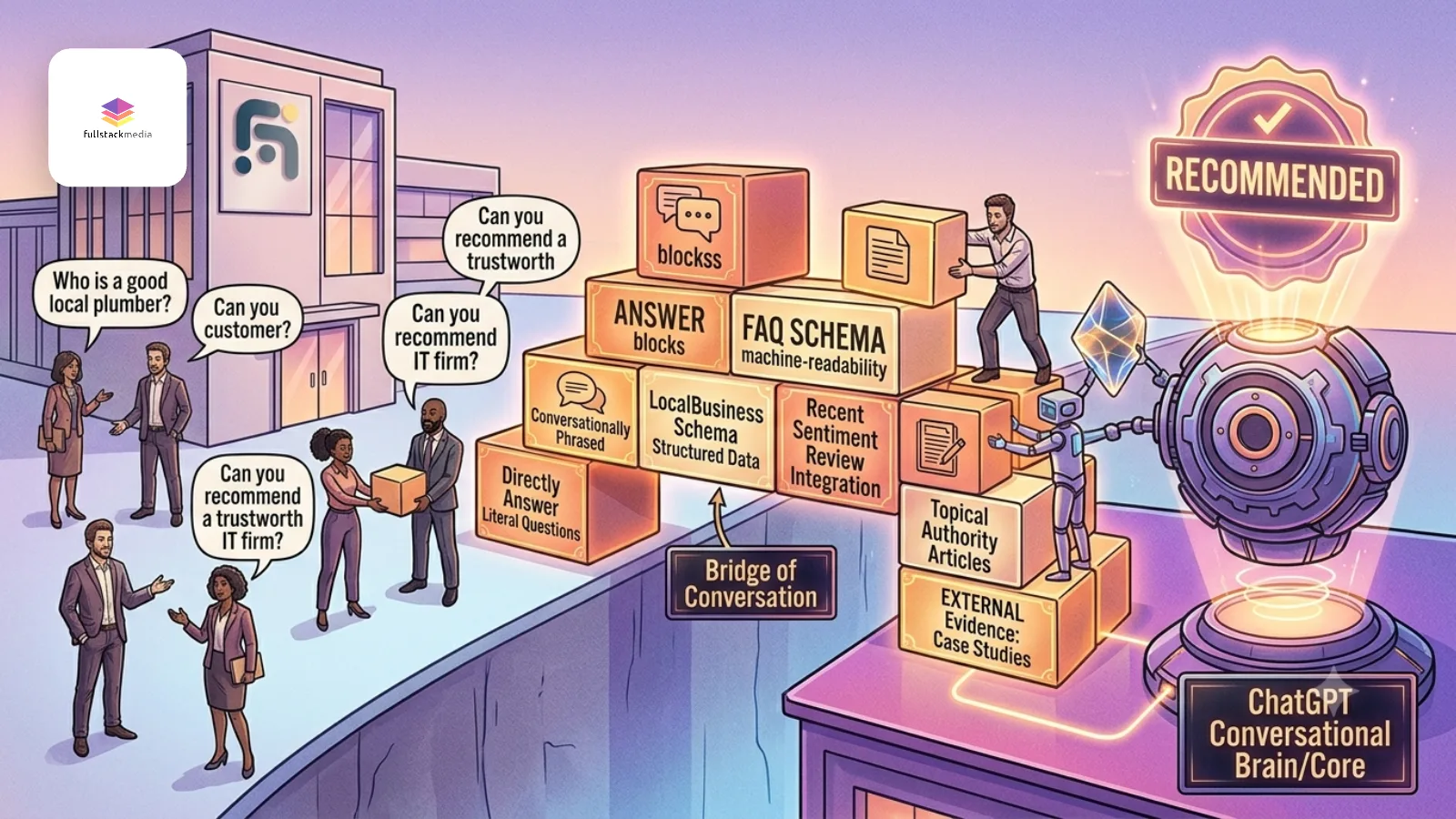
Over the past year we've watched a new pattern appear in our enquiry data, and in the enquiry data of a number of our clients. Contact form submissions coming through with utm_source=chatgpt.com tagged on the end of the URL. Someone asks ChatGPT a question, ChatGPT points them at a business, and they click through and get in touch.
ChatGPT was the first, and for a while it was the only one. But as the other tools have grown in popularity we've started to see the rest follow: enquiries arriving with Copilot tags attached, and visits landing from claude.ai. I won't pretend it's a flood. It isn't. But the pattern is clear: people are asking AI tools who they should work with, and the tools are answering with the names of real businesses.
If you run a business, that raises an obvious question. When someone asks ChatGPT for "a financial adviser I can trust with my pension" or "the best beauty salon on the south coast", is your business part of the answer, or is your competitor's?
Let me walk you through what's happening, why your Google rankings don't automatically carry over, and what you can actually do about it.
People are asking AI for recommendations, and acting on them
For twenty years, finding a supplier meant typing something into Google and picking from a list of links. That behaviour is shifting. Research from GWI found that 31% of Gen Z already use AI platforms or chatbots as their main way of finding information online, and Semrush predicts traffic from AI tools will overtake traditional Google search by the end of 2027.
Right now, AI referrals are still a small slice of most websites' traffic, around 1% of all visits in early 2026. The reason it's worth your attention anyway is the quality. Industry data puts conversion rates from AI-referred visitors at up to 15.9%, against roughly 1.8% for Google organic traffic. That's not a small difference, and it makes sense when you think about what's actually happening. A Google searcher is comparing ten blue links. A ChatGPT user has been given a direct recommendation by a tool they trust, often after describing their exact situation. By the time they land on your site, they're not browsing. They're checking you out before getting in touch.
How visitors convert, by where they came from
Average conversion rate of website visitors, early 2026
Source: industry conversion benchmarks, 2026
Nearly 9x more likely to convert
We've seen this in our own enquiries. The leads that arrive from AI tools tend to come in warm, with a clear idea of what they want. Small numbers so far, but good ones.
Your Google rankings don't carry over
Here's the uncomfortable bit. You might assume that ranking well on Google means the AI tools will recommend you too. In my experience, and in the data, that assumption is breaking down fast.
Research from Brandlight found that the overlap between Google's top ten results and the sources AI tools actually cite has fallen from around 70% to below 20%. Ranking first on Google no longer guarantees you a seat at the AI table.
How often a top-10 Google result is cited by AI tools
The overlap between Google rankings and AI citations is collapsing
Source: Brandlight, 2026
A drop of more than 50 points
The reason is how these tools build their answers. When someone asks ChatGPT "what's the best marketing agency for a small manufacturing business in the North West", it doesn't run that as one search. It quietly breaks the question into several smaller ones ("marketing agencies North West", "marketing for manufacturing SMEs", "agency pricing small business") and stitches the results together. The industry calls these fan-out queries. What it means in practice is that your content gets many more chances to be found, but only if it clearly answers those smaller, specific questions.
One question, several searches
Pick a question someone might ask an AI tool, and watch what it actually does behind the scenes.
Pick a question above to begin.
Nothing is a single search anymore.
This is why we talk about AIEO (AI engine optimisation) as its own discipline alongside SEO. Same foundations, different game on top.
Five things that get you recommended
None of this requires an enormous budget. It requires doing a handful of unglamorous things properly.
1. Be unmistakably clear about who you are
AI tools recommend businesses they can confidently describe. If your website doesn't plainly state what you do, who you do it for and where you're based, you're asking a machine to guess. Machines don't recommend guesses.
Check that your homepage and service pages say it in plain English, and that your details are consistent everywhere: website, Google Business Profile, LinkedIn, directories. Structured data (schema markup) helps too. Think of it as the label on the tin that machines read first. Organization, FAQ and Article schema are the ones to start with.
2. Answer the questions people actually ask
AI answers are assembled from content that directly addresses a question. Pages that ask and answer real questions ("how much does a new website cost", "SEO or paid ads for a new business") get cited. Vague brochure copy doesn't.
Write for the conversation your customer is having, not the keyword. Comparison content works especially hard here, because comparison-style questions are among the most common things people put to AI tools.
3. Give the tools something worth citing
Princeton University research on generative engine optimisation found that content with statistics, quotations and cited sources improves AI visibility by 30 to 40% over unoptimised content. AI tools want evidence they can repeat.
Real numbers from your own work are the cheapest, most credible evidence you have. It's one of the reasons we publish detailed case studies, like the 754% increase in organic search visibility we delivered for Holborn Assets. A specific, verifiable number gives an AI tool a reason to mention you by name.
4. Use your local advantage
Here's some good news for smaller businesses. Geographic questions ("recommend a web development agency near Poole") are far easier to win than national ones, because the pool of credible answers is smaller. A well-maintained Google Business Profile, genuine reviews and location-specific pages will do more for your AI visibility than most expensive tactics.
In my experience most local SMEs are closer to winning these queries than they realise. The bar is low because almost nobody is trying yet.
5. Get mentioned in places you don't control
AI tools read the wider web, not just your website. Reviews, industry directories, press coverage, community discussions and other people's articles all feed the picture the models build of your business. If the only place that says you're good at what you do is your own website, that's a weak signal. Third-party mentions are the AI era's version of backlinks, and they're earned the same slow, honest way.
Are you recommendable?
Tick the ones that are genuinely true of your business today. Be honest, the machines are.
Close to invisible
AI tools have little to go on. The good news: almost nobody in your area is trying yet, so this gap is very winnable.
Want us to check properly? Give us a shout and we will tell you where you stand.
How to spot AI referrals in your own analytics
This is worth ten minutes of anyone's time, because most businesses already have AI-referred visitors and don't know it.
The tools behave differently, which is why the traffic is easy to miss. ChatGPT usually appends utm_source=chatgpt.com to links it cites. Claude, Perplexity and Gemini don't add tags, but they pass a referrer, so they show up in GA4 as referral traffic from claude.ai, perplexity.ai and gemini.google.com. Copilot passes a referrer from its browser version but mostly nothing from its desktop app.
What each AI tool leaves behind
Pick a tool to see how a visit from it actually shows up in your analytics.
Fingerprint
utm_source=chatgpt.comVisibility
Easy to spotChatGPT usually appends a UTM tag to the links it cites, so these visits are clearly labelled and simple to find in GA4.
chatgpt.com / referralGA4's AI Assistant channel (added May 2026) groups recognised tools automatically, but only from launch onwards, and it cannot catch what arrives with no referrer at all.
Two practical steps:
- In GA4, look for the new AI Assistant channel, which Google added in May 2026. It automatically groups traffic from recognised AI tools. Note it only works from launch onwards, so it won't reclassify your history.
- Treat whatever number you find as a floor, not a ceiling. Between 35% and 70% of AI-referred visits arrive with no referrer at all and get lumped into "Direct". If your Direct traffic has been creeping up without explanation, some of it is probably AI.
Most of your AI traffic is hidden
What your analytics attributes to AI, versus what is actually arriving
What you see
The GA4 AI Assistant channel, plus tagged ChatGPT visits
What is really there
Untagged visits from Claude, Perplexity and others, lumped into Direct
Treat whatever your analytics reports as a floor, not a ceiling. If Direct traffic has been creeping up without explanation, some of it is AI.
We check for this as standard in our SEO and marketing audits, and it's surprising how often a business is already being recommended by AI tools without anyone having noticed.
My honest view
There's a lot of noise around AI search right now, and plenty of people selling expensive tools and shiny acronyms off the back of it. We've written before about why most AI projects fail, and the short version applies here too: the fundamentals matter more than the tools.
My honest view is that AIEO is not a replacement for SEO, it's an extension of it, and the businesses that win will be the ones that do both properly rather than chasing either in isolation. Done right, the work compounds: clear content, real evidence and a solid technical foundation make you visible on Google and citable by AI at the same time. Done incorrectly, you end up buying dashboards, chasing acronyms and neglecting the basics that make any of it work.
Why the two work best together
Done right, the work compounds. It does not simply add up.
Visible on Google, easy for AI to overlook
Cited by AI, but built on a shaky organic foundation
Visible on Google and citable by AI, and each one strengthens the other
Clear content, real evidence and a solid technical foundation make you visible on Google and citable by AI at the same time.
The window is real, though. Nearly half of brands have no AI visibility strategy at all, and the overlap between Google rankings and AI citations is still wide open. That gap is the best opportunity smaller businesses have had in years to get recommended ahead of bigger, slower competitors. It's exactly why we build AIEO into our SEO work as standard rather than selling it as a bolt-on.
If you'd like to know whether AI tools are already sending you traffic, or why they aren't yet, give us a shout. We'll take an honest look and tell you where you stand.