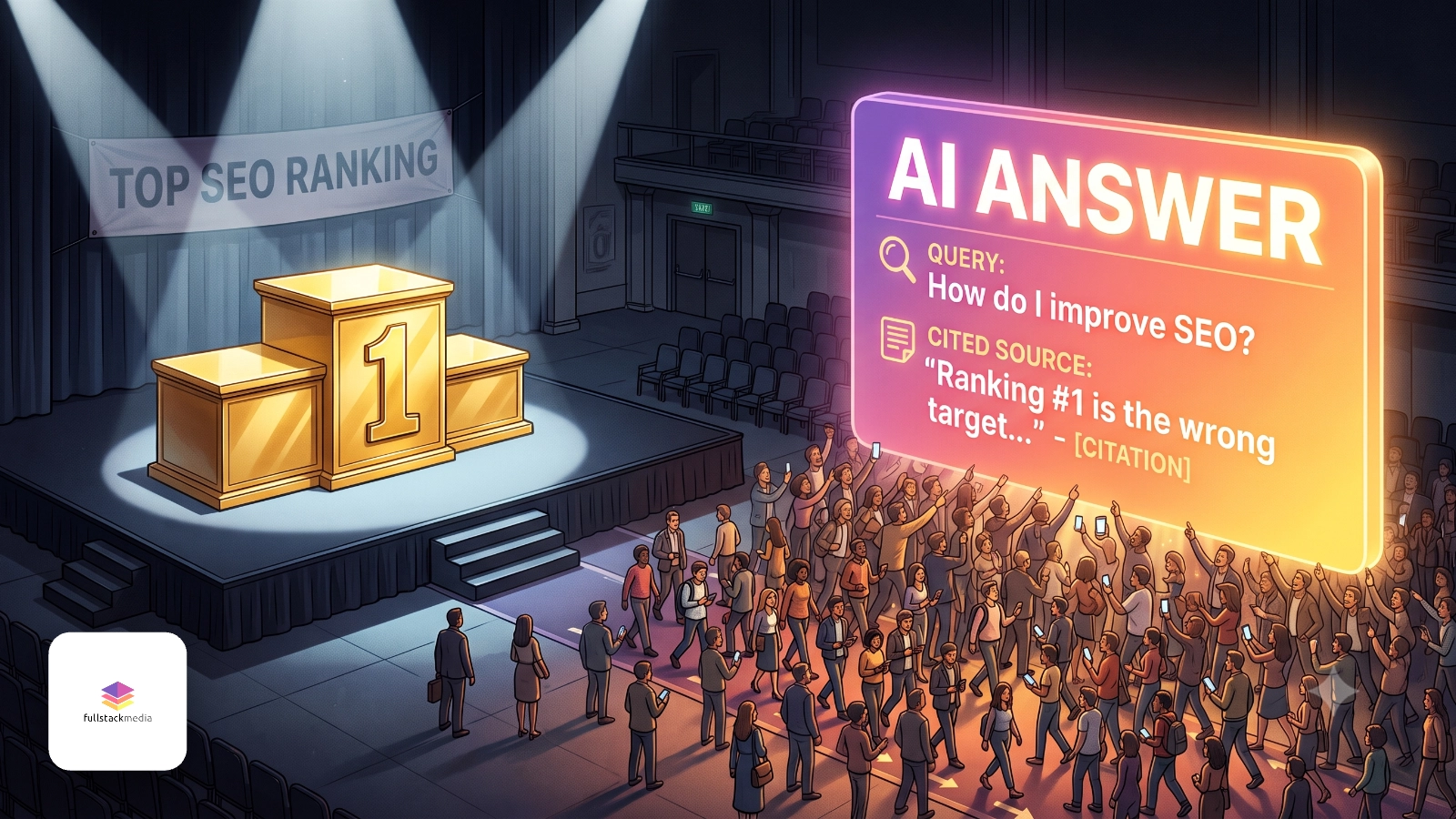
For twenty years, SEO meant one thing: rankings. Get on page one, hit position one, hold it there. Everything else would follow. That was the brief, and for a long time it worked.
It does not work the same way anymore. We hit a turning point in May 2026 when Google announced AI Mode had a billion monthly users.1 Queries are doubling every quarter. The search interface has been redesigned for the first time in 25 years. Autonomous search agents are being tested that will crawl the web on your behalf and return with answers. The product Google is building looks less and less like the ten blue links that defined two decades of digital marketing.
Ranking position one no longer predicts what you might expect it to.
When Rankings and Visibility Stopped Being the Same Thing
Here is the problem in plain terms. In the past, websites ranking in Google's top ten were cited by AI tools roughly 75% of the time. That number has now dropped to between 17% and 38%.2
That collapse needs explaining, because the stat on its own does not tell you why. AI tools like Google's AI Overviews, ChatGPT and Perplexity are not simply pulling from whichever pages rank highest for a query. They use a combination of their own training data, real-time web access, Knowledge Graph signals and their own assessment of source authority. None of that maps neatly to "who ranks first."
ChatGPT's browsing and Perplexity's index reward clarity of answer, breadth of citation and recency. Google's AI Overviews draw on E-E-A-T signals and featured snippet data in ways that have always existed in the ranking algorithm but now operate independently of position. The two graphs, who ranks and who gets cited, have diverged sharply.
How often a top-10 Google result appears in AI-generated answers
The overlap between traditional organic rankings and AI citations has collapsed
Source: The Slide Factory, 2026
58–58 percentage point drop in two years
AI Overviews are now triggered on over 13% of all Google queries, up from 6.5% a year ago.3 When they appear, organic click-through rates drop 61%.4 That is not a glitch. That is a shift. HubSpot documented a 70-80% decline in traffic to broad informational content as AI absorbed the demand that content used to capture.5 And 60% of Google searches now end without a click at all. In AI Mode, that figure is 93%.6
There is something deeper underneath those numbers. People are increasingly bypassing Google entirely. When someone opens ChatGPT, Claude or Perplexity to research a question, that query never appears in Google's ecosystem at all. No impression, no click, no Search Console data. It is simply gone. ChatGPT users now send 2.5 billion prompts per day, more than double the figure from December 2024, and Ahrefs estimates those account for the equivalent of around 12% of Google's daily search volume when filtering for queries that would traditionally have been made on a search engine.9 Google searches per US user fell nearly 20% year-on-year in 2025.10 In 2024, Gartner predicted traditional search engine volume would drop 25% by 2026 as AI chatbots absorbed more intent, and that forecast is looking well-founded.11
If your agency is sending you a monthly report showing position one as a win, ask yourself what that position is actually delivering.
Here's What's Actually Worth Paying Attention To
Brands that get cited inside AI Overviews see 35% more organic clicks and 91% more paid clicks than competitors ranking for the same queries but not appearing in the AI answer.7
The commercial value of being cited in an AI answer
Brands cited in AI Overviews vs competitors ranking for the same queries but not cited
more organic traffic vs competitors ranking for the same query but not cited
more paid traffic vs competitors ranking for the same query but not cited
Source: Authority Tech / Google I/O 2026 AI Search Analysis
Being named in the answer is now more commercially valuable than holding position one below it. The two are optimised for by different means. Understanding that is the whole game.
What the AI Tools Are Actually Using to Decide Who Gets Cited
The industry spent twelve months arguing about terminology: AEO, GEO, AIEO. In May 2026, Google settled it by publishing guidance stating these approaches are "still SEO" and explicitly calling out things that do not drive citation, including llms.txt files and AI-specific schema markup.8 So what does drive it? The evidence connects directly to the next section.
What Has Actually Changed
Direct-answer formatting
This is the biggest shift in twenty years of SEO practice, and it is worth pausing on.
For two decades, the job was getting keywords into content naturally so Google understood what a page was about: keyword density, semantic signals, related terms, proximity. The whole discipline was built around signalling to a machine what a page covered.
The new job is completely different. It is simply asking a question and answering it clearly, then letting the AI work out what the page is about. You are not optimising for the machine's reading comprehension anymore. You are optimising for its ability to quote you directly. Write the question. Answer it plainly. The AI does the rest.
For anyone who has spent years thinking about keyword strategy, this is not a minor tweak. It is a different way of thinking about what content is for.
Conversational query patterns
Even within Google, what people search for is changing. Google's own Year in Search data for 2025 shows queries starting with "Tell me about" grew 70% year-on-year, while "How do I" searches hit an all-time high.12 Analysis of Google Ads search data found that queries of seven to eight words nearly doubled in the period following the launch of ChatGPT.13
Someone who used to type "SEO agency Bournemouth" is now more likely to ask "which digital agency should I use if I want better SEO results and my site needs a rebuild." That is a different query with different intent, and it demands a different kind of answer.
The same logic driving AI citation patterns is driving this shift. Users are no longer satisfied by results that match their keywords. They expect results that answer their actual question. The SEO job is not to fit the keyword in. It is to be the clearest answer to the question someone is genuinely asking.
Unique data and perspective
AI cannot cite what it cannot distinguish from everything else.
Content that contains proprietary data, primary research, specific case studies or a clearly stated point of view that does not exist elsewhere gives the system something quotable. Generic content, however well-optimised for traditional ranking factors, is increasingly invisible to citation algorithms.
If your content could have been written by anyone, AI has less reason to single it out.
Brand authority signals
Being referenced in trade publications, industry reports, news coverage and credible directories builds the signal that tells an AI this source is worth including.
This has always been part of the SEO picture. It is now amplified, because it influences citation independently of traditional ranking position. PR and content marketing are no longer separate from SEO strategy. They are part of the same effort.
Technical foundations
We can guarantee a fast-loading site, Core Web Vitals addressed at the architecture level rather than patched at the surface, and structured data implemented properly. We cannot guarantee you will rank or be cited, because those outcomes involve factors no one fully controls. But a site built on weak technical foundations is at a compounding disadvantage, and we have fixed that problem on projects where it had been left unresolved for years.
This site, the one you are reading this article on, is a live example of what that looks like in practice.
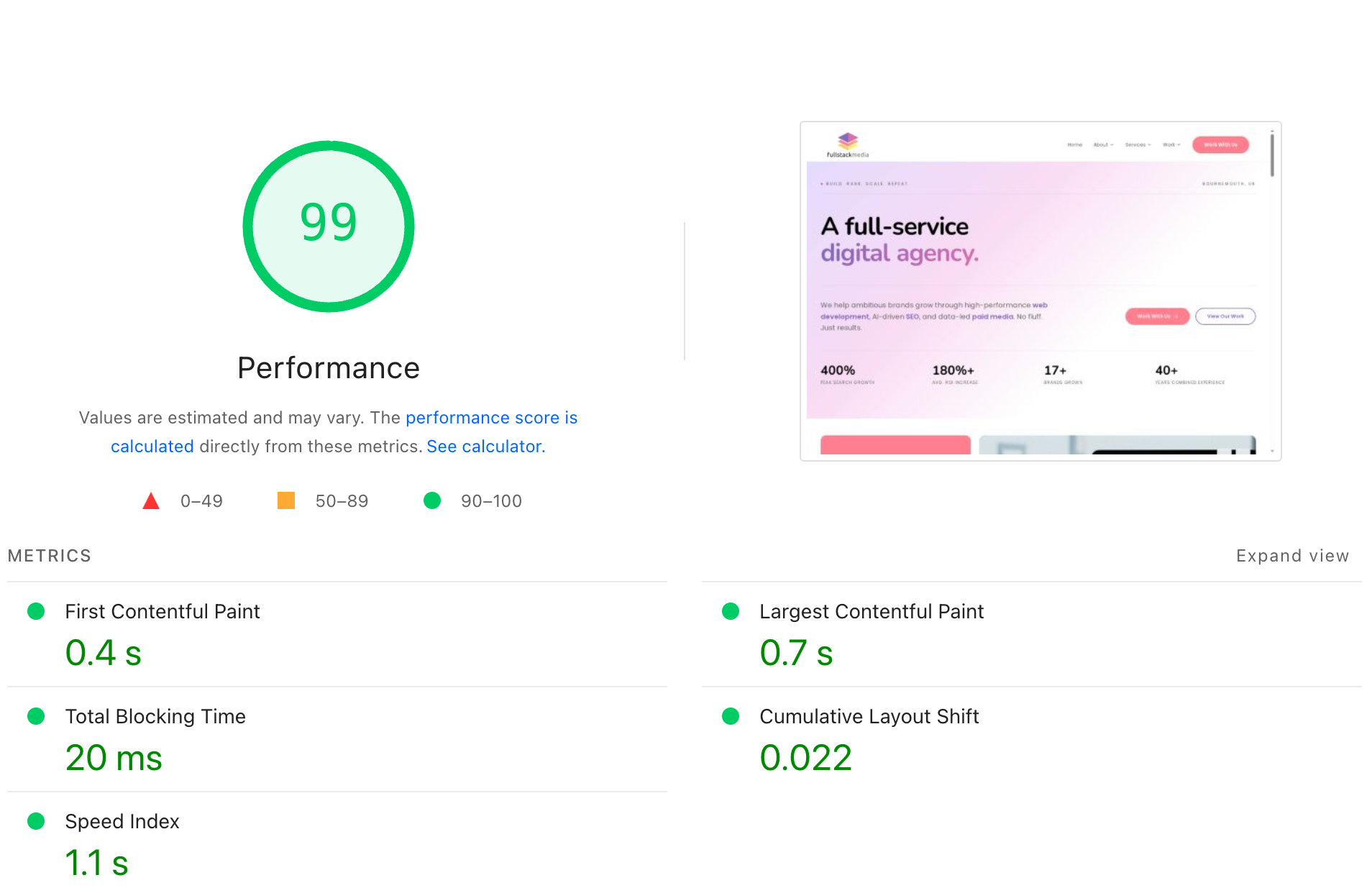
Full Stack Media's own site: 99 Performance score, FCP 0.4s, LCP 0.7s, CLS 0.022. Built on the same foundations we deliver for clients.
This Is Evolution, Not Starting Over
Worth saying plainly: none of this means undoing twenty years of work. Users can turn off AI Mode. Traditional organic rankings still matter. We are not at 100% AI citation, and we will not be any time soon.
The right response is to play both angles, optimising for traditional ranking signals and for AI citation simultaneously. They share more common ground than you might expect: quality signals, structured content, technical foundations. The work overlaps far more than it diverges.
The mistake is treating them as entirely separate disciplines, or ignoring one in favour of the other.
The Measurement Problem Nobody Has Solved Yet
Here is where it gets awkward, and it is arguably the most important part of this article.
For most of the last twenty years, Google was search. If it happened in search, it happened in Google. Your Search Console data was your search data. That assumption is no longer valid.
When someone opens ChatGPT, Claude or Perplexity to ask a question, Google has no visibility into that query. At all. It does not appear in any Google property. There is no impression, no ranking, no click data, no insight into what was asked or how it was answered. The query simply does not exist from Google's perspective. As search behaviour migrates toward AI tools at a growing pace, an increasing proportion of relevant search activity is happening completely outside Google's measurement infrastructure.
That is the bigger problem. The more often-discussed issue, that Search Console does not currently separate AI Overview citations from regular impressions, sits underneath it. You cannot open Search Console, click a tab, and see how often you are appearing inside AI answers even on Google itself. There is no dedicated metric. You can sometimes infer it: a position that suddenly jumps to number one with no change in content or backlinks is often an AI Overview citation pulling the average up in the data. But that is a workaround, not a report.
Third-party tools are beginning to address the in-Google blind spot. Ahrefs and Semrush are adding AI Overview tracking. Newer specialist tools are emerging. But no Google tool will ever tell you what is happening on ChatGPT, Perplexity or Claude, because Google genuinely does not know.
The practical consequence is a measurement paradigm that no longer fits the landscape it is supposed to describe. Agencies keep reporting on keyword rankings because rankings are what Search Console shows and what clients recognise. Clients accept ranking reports because they have been trained to, and because Google built the tooling that made rankings the default success metric. Nobody in that arrangement can see what is happening outside the Google ecosystem.
The incentive structure is not broken because people are dishonest. It is broken because the tools that govern it were built for a world where Google was the whole of search, and that world is changing faster than the reporting has caught up with.
The businesses that move ahead of this will not just be asking how they perform in Google's data. They will be asking what their visibility looks like across all the places where relevant queries are now being answered, and building measurement approaches that account for the full picture rather than the Google-shaped slice of it.
You cannot manage what you cannot measure. The question is whether you are measuring enough.
What This Means Practically
Content. The brief shifts from "rank for this keyword" to "be the source that answers this question." These produce different content. One is written for a crawler. The other is written to be quoted.
Brand authority. PR, industry publishing, third-party coverage and partnerships that put your name in credible sources have always mattered for SEO. They now also drive AI citation directly. The two channels have merged.
Technical. Structured data done properly. Core Web Vitals at the architecture level. A fast site. Table stakes, but most sites are not meeting them.
Measurement. Supplement ranking reports with the best available proxies for citation performance: position anomalies in GSC, branded search volume trends, direct traffic patterns and third-party AI visibility tools. It is imperfect. It is better than the alternative.
The agencies reporting purely on keyword positions and presenting that as the full picture of search performance are telling an incomplete story. The gap between what they are measuring and what is actually happening in search is growing every quarter.
The question is whether the business paying for that reporting knows it yet.
References
- Google AI Mode surpasses 1 billion monthly users — Google Blog, May 2026
- Google AI Mode SEO Impact 2026 — The Slide Factory
- AI SEO Statistics 2026 — Omnibound
- Google AI Overviews SEO Impact — Stackmatix
- Organic Traffic Crisis Report 2026 — The Digital Bloom
- Zero-Click Search Statistics 2026 — Digital Applied
- Google I/O 2026 AI Search Changes — Authority Tech
- Google's New AI Search Guide Calls AEO And GEO 'Still SEO' — Search Engine Journal
- ChatGPT Has 12% of Google's Search Volume — Ahrefs, February 2026
- Google Searches Per US User Down Nearly 20% — Datos / SparkToro Q4 2025 State of Search, via MarTech
- Gartner Predicts Search Engine Volume Will Drop 25% by 2026 Due to AI Chatbots — Gartner, February 2024
- Year in Search 2025 — Google Blog, December 2025
- How Search Query Length Is Shifting in the LLM Era — Search Engine Land