Eighty percent of AI projects fail. Not fifty. Not sixty. Eighty. That is approximately twice the failure rate of traditional technology projects, and the number sits there as a rebuke to everyone who has been told this is simple.1
42% of companies have now abandoned most of their AI initiatives, up from 17% in 2024.2 At the same time, 93% of SMEs that have successfully implemented AI report positive business impact.3 Both of those things are true at the same time, and the gap between them is not explained by the tools. It is explained by everything else.
80%
of AI projects fail
Roughly twice the failure rate of traditional technology projects
42% of companies have abandoned most of their AI initiatives
93%
of successful implementations report positive impact
Among SMEs that have properly implemented AI
Both numbers are true at the same time
Before getting into what goes wrong, there is a more important point to make first. It reframes the whole conversation.
AI Does Not Create Problems. It Surfaces Them.
One of the most important things to understand about AI in a business context is this: when a project surfaces issues with data, processes or systems, it is almost never discovering something new. The data has always been messy. The processes have always had gaps. The systems have always been less joined up than anyone would like. Businesses have always looked at their data and their operations, but at human speed, in human detail, within human capacity.
What AI does is accelerate that scrutiny massively. It delivers a level of detail and cross-referencing that no team could match manually, and it connects the dots across a business faster than any analyst working alone. Problems that existed for years suddenly become impossible to ignore, because the tool has made them impossible to miss.
When an AI project surfaces a data problem that derails the initiative, that is not the AI failing. That is the AI working, finding what was already broken, and exposing it at a speed that makes it feel sudden. The failure was in the foundation underneath it, and it would have been there whether the AI came along or not.
Problem One: The Data Is Not Ready
60% of AI projects started in 2026 are projected to be abandoned because the underlying business data is not AI-ready.4
Let me give you a specific example of what this looks like in practice, drawn from direct experience. The business stays anonymous.
A couple of years ago, a large, established and genuinely profitable business brought in a data analyst. The expectation was clear: the analyst would surface insights that improved conversion and sharpened client relationships, among other things they had not yet identified. What they found instead was that the data was in such poor condition they effectively had to go back to the drawing board on the entire system and rethink the business processes around it. The data was not just incomplete. It was so badly structured, inconsistently recorded and spread across siloed systems that there was nothing meaningful to analyse. The analyst was eventually made redundant, not because they could not do the job, but because there was no job to do yet. The business was several years away from being ready for that kind of work.
An AI could do a data analyst's job today, quickly and with far more depth and breadth than any individual analyst. Put that AI in the same situation and it would hit the same wall, just faster. The failure was never the analyst. It was never the tool. It was the data underneath.
This is not unusual. It is the norm in established businesses, and it happens for a straightforward reason.
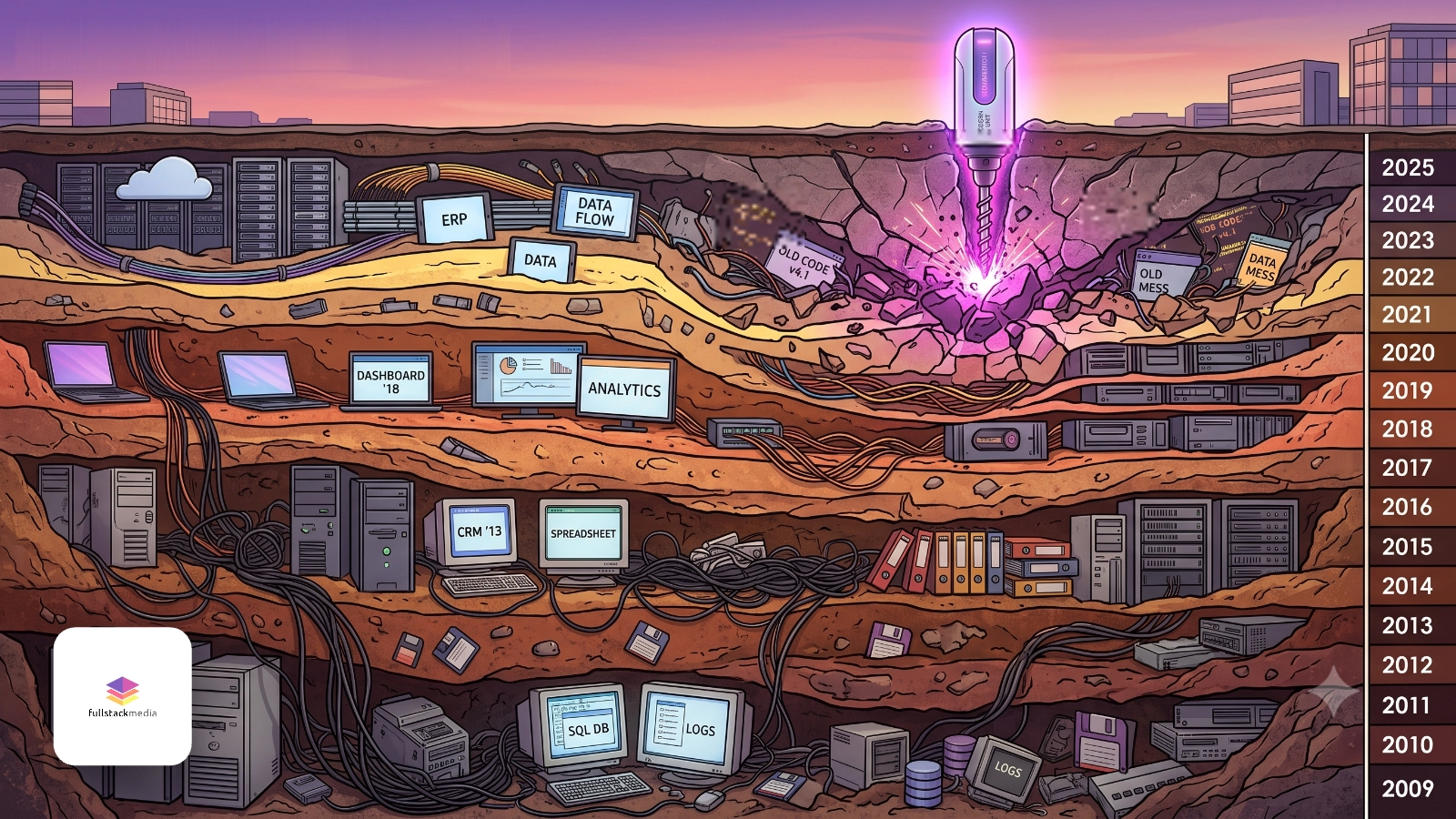
People come and go. Managers change. Priorities shift. Every time someone leaves and someone new arrives, systems get adapted to new habits and new ways of working. Nobody deletes what came before. They layer on top of it. After fifteen years, you have fifteen layers, and somewhere in there is the spreadsheet that Sandra in accounts keeps, the one that only she fully understands, that bridges a gap between two systems that were never properly integrated. That spreadsheet is not a problem until you try to plug an AI into the data and discover that half the logic the business runs on lives in it, undocumented, in a format nothing else can read.
How fifteen years of decisions accumulate
Select any layer to see what it represents and why it matters when an AI project arrives.
This pattern is the norm in established businesses. It is not the exception.
This is why institutional knowledge matters as much as the technology in any AI project. The long-standing employees who know why a decision was made, who was responsible for a particular system, how the business arrived at its current processes: those people are not peripheral to an AI implementation. They are central to it. They are the ones who can help untangle the history so the data can be cleaned, organised and made ready for what comes next.
Problem Two: The People Implementing It Are Often Playing Catch-Up
I have this conversation regularly. A business leader has heard something on the radio or read a piece about AI. They come in asking whether the company is doing enough with it. They want something visible, something that shows the business is engaged. The team scrambles to respond. Something gets delivered that looks relatively impressive in the short term. Does it genuinely change the business? Does it move the needle? Usually not.
That is not a criticism of the business leader or the team. It is a description of where most organisations sit in 2026, and it is one of the most common routes into an AI project that costs money and delivers very little.
Walk into any organisation and you will find roughly three kinds of people when it comes to AI. There are those who are scared of it, in the same way people were once scared of computers or of being hacked, and who disengage as a result. There are those willing to have a go, curious and open but not really up to speed on what the tools can actually do or how to use them effectively. And then there are those diligently following how the technology is developing, working out how specific tools apply in their specific context, and coming in excited: "did you know it can do this? I would love to change this process because it can work like this now."
That last group is invaluable. They are the people who make AI implementations actually work, because they understand both the capability and the context. Most organisations do not have enough of them, and that gap, between what the tools can do and what the average person implementing them knows, is growing faster than most training programmes can close it.
Which one are you?
Walk into any organisation and you will find roughly three types of people when it comes to AI. Select the one that fits.
Good AI implementation is a genuine skill set: knowing what a model can and cannot do reliably, designing workflows that produce consistent outputs, building the review layers that catch errors before they compound, and connecting the AI to the data that makes it specifically useful. Pretending that skill set is widely distributed is how projects get approved with unrealistic expectations and handed to frustrated stakeholders six months later.
Problem Three: People Are Scared
There is an anxiety running through most organisations that is rarely stated directly but shapes almost every AI conversation. The fear of replacement. If this tool can do my job, what happens to my job?
These are not irrational questions. What is true is that the opportunity in AI is not to do the same work with fewer people. It is to do more valuable work with the same people. Removing the low-value, repetitive, error-prone tasks that consume time and generate mistakes, and redirecting that capacity toward work that requires judgement, relationships and genuine expertise.
A marketing team that uses AI well does not shrink. It produces better work faster with the same headcount. A development team that integrates AI into how it works does not disappear. It ships more, catches more, and has more time for the decisions that actually matter.
But that outcome requires people to engage with the tools rather than resist them. Fear of replacement is one of the primary reasons they resist. Addressing that honestly, rather than papering over it, is part of what makes AI implementation succeed or fail.
There is a broader point here about what AI actually does to the people who embrace it, to their productivity, their capability and their sense of what becomes possible. That is a conversation I have written about separately, and it is worth reading alongside this piece: The Productivity Paradox: Why AI Made My Workload Heavier.
Why Legacy Businesses Struggle Most
There is a reason large, established businesses tend to move more slowly with AI than smaller or newer ones. The history is the problem.
Consider banking. For decades, established banks ran on systems a generation old, required customers to visit a branch for basic transactions, and moved at the pace of an industry with no competitive reason to change. Then Monzo arrived with no legacy systems, no branches, no inherited processes, and built from scratch something that let customers photograph a cheque to pay it in. It reshaped the sector. Not because established banks did not understand what was possible, but because they could not unravel twenty years of infrastructure and process fast enough to respond.
Tesla did the same with cars. Not just an electric vehicle, but a rethink of the car as a product, the sales model, the software relationship, the service model. Built from nothing, without the weight of existing dealer networks and century-old manufacturing logic.
Chinese car manufacturers are doing it again now, arriving in European markets with genuinely new ideas and clean systems, while established European manufacturers are still working out how to respond without dismantling everything that made them what they are.
The pattern is consistent: the business with no history to untangle moves faster, thinks more clearly, and builds more competitively. AI does not change that dynamic. It amplifies it. A business with clean, well-structured data and modern systems will implement AI faster, more reliably, and with better outcomes than one that has to spend two years getting the foundations ready first.
That is not a reason to give up if you are the established business. It is a reason to start the data and process work now rather than waiting until you feel ready for AI. Getting the foundations in order is the project. The tools come after.
What Actually Works
The businesses reporting genuine positive outcomes from AI have a common pattern. They sorted the data before they touched a tool. They made sure the people involved understood the capability at a real level, not just the surface function, before deploying anything at scale. And they treated AI as an operational change requiring process design and clear accountability, not a software subscription requiring an onboarding call.
In practice: audit the data before you automate anything. Invest in capability, not just licences. Design the points where human review happens and where accountability sits. Start with one process, run it properly, measure it, and build from there.
What the successful 20% have in common
The businesses reporting genuine positive outcomes from AI follow the same pattern.
Sort the data first
Audit what you have before automating anything. If the data is messy, inconsistent or siloed, the AI will surface that immediately — and the project will stall. Better to know before you build.
Invest in capability, not just licences
Buying access to an AI tool is not the same as knowing how to use it well. Designing workflows, reviewing outputs reliably, and knowing where the model cannot be trusted — that skill set is what drives results.
Design the human review points
Decide in advance where a person checks the output, where accountability sits, and what happens when the AI gets it wrong. These are not afterthoughts to add later — they are part of the implementation.
Start with one process
Pick something specific. Run it properly. Measure it against what you expected. Fix what needs fixing. Then build from there. Breadth before depth is how AI projects collapse.
AI is the most significant operational shift most businesses will navigate in the next five years. The way through it is methodical, honest about where you currently are, and serious about the foundations.
Waiting for the perfect moment to start is how you end up five years behind.
References